A Technical Guide To Prediction Markets
A Comprehensive Typology of Forecasting Projects

Prediction markets represent a rapidly evolving intersection of economics, technology, and collective intelligence. Sometimes referred to as ‘information markets’, ‘idea futures’ or ‘event futures’, prediction markets where participants trade contracts whose payoffs are tied to a future event, thereby yielding results that can be interpreted as market-aggregated forecasts.
Prediction markets are contract-based markets that track the outcome of specific events.
This piece provides a comprehensive technical analysis and classification system for contemporary forecasting projects, whilst examining their underlying mechanics, technological infrastructure, and operational tradeoffs.
I do this through systematic categorization based on prediction type, resolution mechanisms, technical architecture, and incentive structures, also identify several distinct types of prediction market platforms and analyze their respective strengths, weaknesses, and real-world implementations.
#1 Prediction Type and Complexity in Prediction Markets
Prediction markets generate forecasts by aggregating participant inputs, with the type and complexity of predictions shaping their technical design, computational demands, and market applicability. This typology classifies platforms by the nature of their predictive outputs; Binary, Scalar (Numerical), and Combinatorial (Multi-Outcome), each requiring distinct algorithms, data structures, and computational resources
1. Binary Prediction Markets
Binary prediction markets resolve to simple yes/no or true/false outcomes, making them the least computationally complex. They are ideal for event-based forecasts, for exmple“Will Candidate X win the 2026 election?”) and rely on classification algorithms like logistic regression, decision trees, or simple majority voting to aggregate participant bets.
In decentralized platforms, smart contracts encode binary logic, while centralized platforms use internal databases. The market aggregates participant stakes (share purchases for “Yes” or “No”) to estimate probabilities, often represented as prices between 0 and 1.
Technical Details:
Aggregation: Market prices reflect the weighted average of participant bets, interpreted as the probability of the “Yes” outcome.
Resolution: A binary condition (e.g., event occurred or not) triggers payouts, with winners receiving a fixed payoff.
Algorithms: Logistic regression or majority voting aggregates predictions, minimizing computational overhead.
Data Structure: Simple key-value stores or smart contracts suffice, storing bets and outcomes.
Mathematical Formula (Market Probability):
Let Syes and Sno be the total stakes (e.g., funds or shares) on “Yes” and “No” outcomes. The implied probability of “Yes” is:
The payout for a winning share is:
Code Example (Solidity for Binary Market):
// SPDX-License-Identifier: MIT
pragma solidity ^0.8.0;

contract BinaryMarket {
    uint256 public yesShares;
    uint256 public noShares;
    bool public resolved;
    bool public outcome; // True for Yes, False for No
    mapping(address => uint256) public yesBets;
    mapping(address => uint256) public noBets;

    function bet(bool _choice) public payable {
        require(!resolved, "Market resolved");
        if (_choice) {
            yesShares += msg.value;
            yesBets[msg.sender] += msg.value;
        } else {
            noShares += msg.value;
            noBets[msg.sender] += msg.value;
        }
    }

    function resolveMarket(bool _outcome) public {
        require(!resolved, "Market already resolved");
        outcome = _outcome;
        resolved = true;
        // Payout logic: Winners receive 1:1 based on shares
    }

    function getProbability() public view returns (uint256) {
        if (yesShares + noShares == 0) return 0;
        return (yesShares * 100) / (yesShares + noShares); // Probability as percentage
    }
}
This contract tracks bets on a binary outcome and calculates the implied probability.
Platform Examples
Kalshi: A CFTC-regulated platform for binary event contracts. It uses centralized systems to aggregate bets and resolve simple yes/no outcomes.
Omen (Gnosis): A decentralized platform on Gnosis Chain for binary markets.Smart contracts handle binary outcomes with on-chain aggregation, minimizing computational overhead.
PredictIt: A U.S.-based platform for political predictions. Centralized database tracks yes/no bets, resolving via official data with simple logic.
SWOT Analysis
Strengths:
Low Complexity: Minimal computational requirements enable fast, efficient markets.
User-Friendly: Binary outcomes are intuitive, attracting non-technical users.
Scalability: Handles high-volume markets due to low resource demands.
Regulatory Fit: Simple structure aligns with recent CFTC rules, enabling legal operation.
Broad Applicability: Supports diverse events with clear true/false outcomes.
Weaknesses:
Limited Granularity: Cannot handle continuous or complex predictions, restricting market types.
Low Information Depth: Binary outcomes provide less insight than scalar or combinatorial predictions.
Liquidity Dependence: Requires high participation to ensure accurate probabilities.
Subjectivity Risk: Ambiguous event definitions can lead to disputes.
Opportunities:
Mainstream Adoption: Simplified UX could attract casual users, expanding platforms.
Layer 2 Integration: Decentralized platforms like Omen could use rollups to reduce costs, boosting scalability.
Event Diversification: Expanding to new binary events (e.g., esports, weather) could grow markets.
AI Enhancement: Machine learning could improve probability estimation, enhancing accuracy.
Cross-Platform Synergies: Standardized binary formats could enable liquidity sharing across platforms.
Threats:
Regulatory Restrictions: CFTC or global rules may limit market types (e.g., Kalshi’s U.S.-only focus).
Competition: Scalar and combinatorial platforms offer richer insights, potentially overshadowing binary markets.
Low Engagement: Niche or poorly defined markets may fail to attract bettors, reducing accuracy.
Manipulation Risks: Low-liquidity markets are vulnerable to whale manipulation.
Outcome Disputes: Ambiguous resolutions can erode trust.
2. Scalar (Numerical) Prediction Markets
Scalar prediction markets forecast continuous numerical values (e.g., “What will Tesla’s stock price be in 2026?”), requiring regression models or optimization techniques like least squares to aggregate participant predictions. These markets are more complex than binary ones, as they handle a range of outcomes rather than a single yes/no decision. Participants submit numerical predictions, often weighted by stake or confidence, and the market aggregates these into a final value, typically the median or mean. Resolution compares the aggregated prediction to the actual outcome, with payouts based on accuracy.
Technical Details:
Aggregation: Predictions are combined using weighted averages or medians, optimized to minimize error (e.g., mean squared error).
Resolution: The actual outcome determines payouts, often proportional to prediction accuracy.
Algorithms: Linear regression, kernel methods, or robust statistics handle outliers and noise.
Data Structure: Requires arrays or databases to store numerical predictions and compute aggregates.
Real-World Examples
Hypermind: A forecasting platform for numerical predictions.It uses centralized aggregation of expert numerical inputs, resolving via official data sources.
Metaculus: A community-driven platform for scalar forecasts. Metaculus aggregates user predictions with weighted algorithms, resolving via expert consensus or data.
Cindicator: A hybrid platform using AI and crowd predictions for financial metrics (e.g., crypto prices).It combines user numerical forecasts with machine learning for scalar outcomes.
SWOT Analysis
Strengths:
Rich Insights: Provides precise numerical forecasts offering more granularity than binary markets.
Flexibility: Supports diverse numerical events appealing to specialized audiences.
Accuracy: Weighted aggregation can outperform individual predictions.
Robust Algorithms: Regression and robust statistics handle noisy data, improving reliability.
Broad Applications: Useful for economic, scientific, and financial forecasting (e.g., Metaculus’ AGI timelines).
Weaknesses:
Higher Complexity: Requires advanced algorithms increasing computational demands over binary markets.
Resolution Challenges: Accurate outcome data may be delayed or disputed, complicating payouts.
User Barrier: Numerical predictions require more expertise, deterring casual users (e.g., Hypermind’s expert focus).
Cost: Decentralized platforms (e.g., Cindicator’s blockchain experiments) face higher gas fees for complex calculations.
Data Dependence: Relies on reliable sources for resolution, vulnerable to inaccuracies.
Opportunities:
AI Integration: Advanced ML models could enhance prediction aggregation (e.g., Cindicator’s hybrid approach).
Niche Markets: Expanding to scientific or environmental forecasts (e.g., climate metrics) could grow audiences.
Decentralized Scaling: Layer 2 solutions could reduce costs for on-chain scalar markets.
Corporate Adoption: Platforms like Hypermind could target business forecasting (e.g., sales projections).
User Incentives: Staking or rewards could boost participation in complex markets.
Threats:
Regulatory Hurdles: Scalar markets may face scrutiny for financial predictions.
Competition: Binary markets offer simplicity, while combinatorial markets provide richer scenarios, challenging scalar platforms.
Data Risks: Inaccurate or manipulated resolution data could undermine trust.
Low Participation: Complex markets may struggle to attract sufficient bettors, reducing accuracy.
Computational Costs: High processing demands could limit scalability in decentralized systems.
3. Combinatorial (Multi-Outcome) Prediction Markets
These type of prediction markets handle interdependent or multi-faceted outcomes, predicting across multiple variables or scenarios (e.g., “Which company and region will lead EV sales in 2026?”).
These are the most complex, requiring graph-based algorithms, clustering, or ensemble models to aggregate predictions and account for dependencies. Participants bet on combinations of outcomes, and the market computes probabilities for each scenario, often using simulations or Bayesian networks. Resolution involves verifying multiple conditions, increasing computational and data demands.
Technical Details:
Aggregation: Uses combinatorial auctions or graph algorithms to compute joint probabilities across outcomes.
Resolution: Verifies multiple conditions (e.g., via oracles or APIs) to determine the winning combination.
Algorithms: Ensemble models, Markov chain Monte Carlo (MCMC), or belief propagation handle complex dependencies.
Data Structure: Graphs or matrices store outcome relationships, requiring significant storage and computation.
Real-World Examples
Augur: A decentralized platform on Ethereum supporting combinatorial markets. It uses smart contracts and graph-based algorithms to handle interdependent outcomes.
Gnosis Conditional Tokens: Enables markets for multi-outcome predictions on-chain.
Qf (Quantified Futures): A platform for multi-faceted economic forecasts. It uses ensemble models to aggregate complex predictions, often off-chain.
SWOT Analysis
Strengths:
Rich Insights: Captures complex, interdependent scenarios, providing deep predictive value.
Flexibility: Supports intricate markets appealing to specialized audiences.
Advanced Algorithms: Ensemble models and graph algorithms enhance accuracy for complex data.
Scalability in Centralized Systems: Off-chain platforms handle high complexity efficiently.
Strategic Value: Useful for corporate or policy planning.
Weaknesses:
High Complexity: Requires intensive computation increasing costs and latency.
User Barrier: Complex markets deter casual users, requiring expertise.
Resolution Challenges: Verifying multiple outcomes is data-intensive and error-prone.
Cost: On-chain platforms face high gas fees for complex calculations.
Liquidity Needs: Requires significant participation to ensure accurate probabilities, challenging for niche markets.
Opportunities:
AI and ML Advances: Improved ensemble models could enhance aggregation.
Decentralized Scaling: Layer 2 solutions (e.g., Gnosis on xDai) could reduce costs for on-chain markets.
Niche Expansion: Targeting complex domains (e.g., climate impacts, tech trends) could attract new users.
Cross-Platform Liquidity: Standardized combinatorial formats could enable shared liquidity.
Corporate Adoption: Platforms like Qf could expand into strategic forecasting for businesses.
Threats:
Regulatory Scrutiny: Complex markets may face gambling or financial regulations.
Computational Limits: High resource demands could limit scalability, especially on-chain (e.g., Gnosis’ gas costs).
Competition: Simpler binary or scalar markets (e.g., Kalshi) may attract more users due to accessibility.
Data Risks: Multi-outcome resolution requires reliable data, vulnerable to errors or manipulation.
Low Adoption: Complexity may deter participation, reducing market accuracy.
#2 Outcome Resolution and Verification Mechanisms
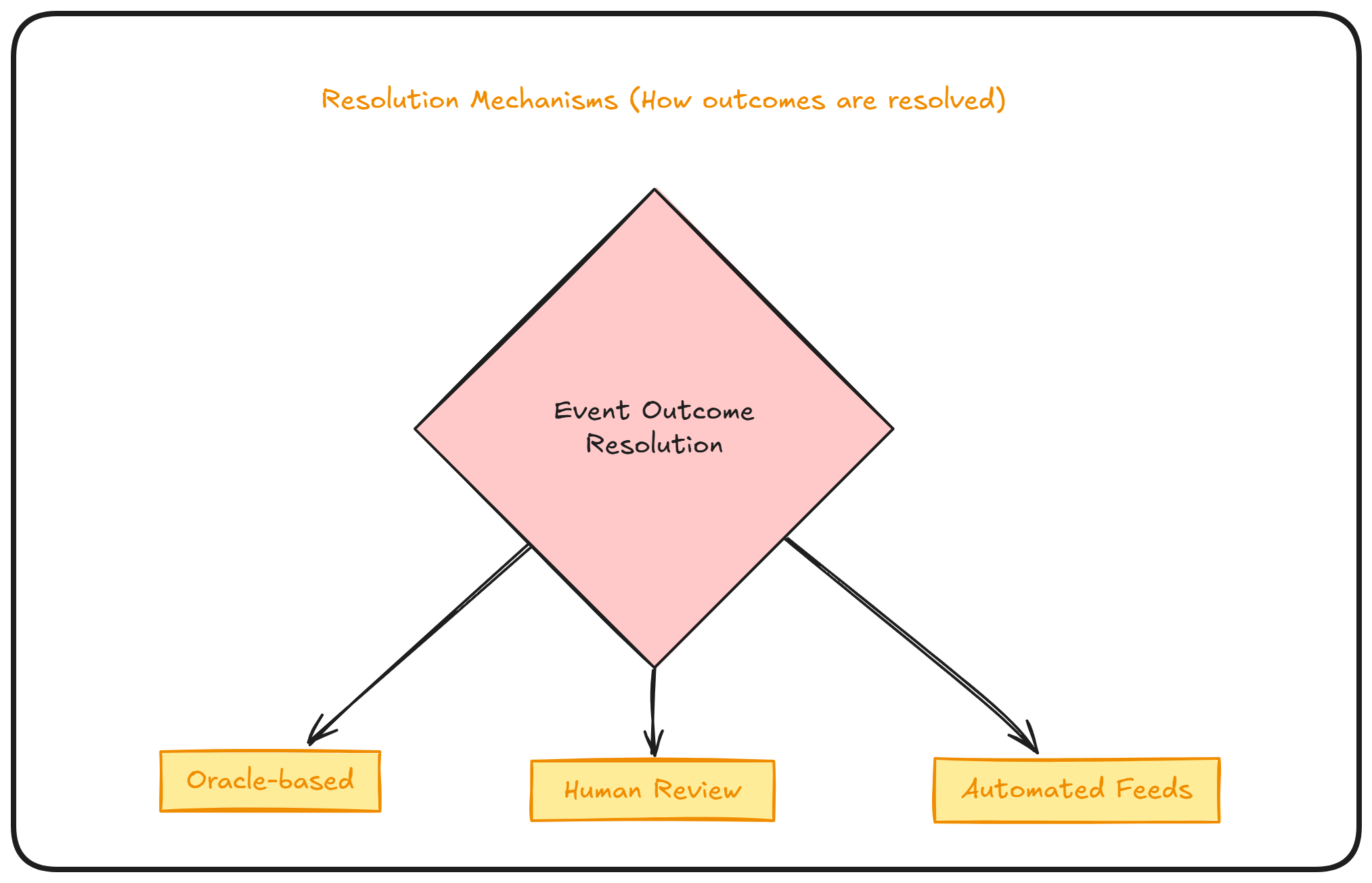
Outcome resolution and verification mechanisms are critical to ensuring trust, accuracy, and fairness in prediction markets. These mechanisms determine how platforms confirm the outcome of events (e.g., election results, price movements) and distribute payouts to participants. The choice of mechanism impacts speed, scalability, cost, and reliability, particularly in real-time or uncertain environments. This section explores four primary approaches; Oracle-Based, Human-Reviewed, Automated Feed-Based, and Hybrid Resolution.
1. Oracle-Based Resolution
How It Works
Oracle-based resolution relies on external data feeds, typically provided by decentralized oracles like Chainlink or Pyth, to deliver real-world data to smart contracts on a blockchain. These oracles act as bridges between off-chain data sources (e.g., election results, sports scores) and on-chain logic. The process is fully deterministic, with smart contracts automatically executing payouts based on the oracle’s data. Oracles aggregate data from multiple sources to ensure accuracy, often using a weighted average or median to mitigate manipulation risks.
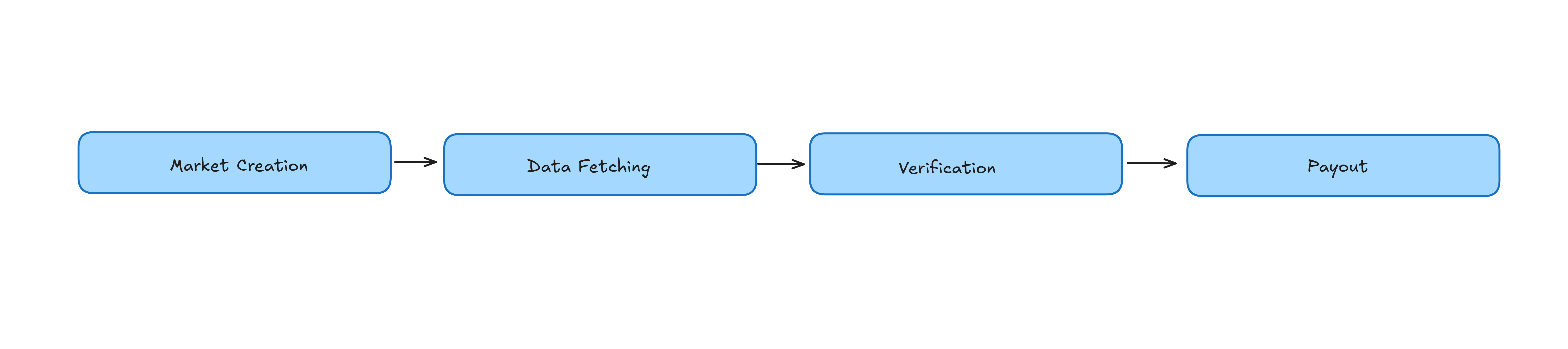
Technical Workflow:
Market Creation: A smart contract defines the event (e.g., “Will Bitcoin exceed $100,000 by December 2025?”) and specifies an oracle as the data source.
Data Fetching: At resolution time, the oracle queries external APIs (e.g., news outlets, price feeds) and submits the result to the blockchain.
Verification: The smart contract validates the oracle’s input (e.g., checking signatures or consensus among multiple oracle nodes).
Payout: The contract distributes funds to winners based on the resolved outcome.
Code Example (Solidity for Chainlink Oracle Integration):
// SPDX-License-Identifier: MIT
pragma solidity ^0.8.0;
import "@chainlink/contracts/src/v0.8/interfaces/AggregatorV3Interface.sol";

contract PredictionMarket {
    AggregatorV3Interface public oracle;
    address public owner;
    bool public resolved;
    int public outcome;

    constructor(address _oracle) {
        oracle = AggregatorV3Interface(_oracle);
        owner = msg.sender;
        resolved = false;
    }

    function resolveMarket() public {
        require(!resolved, "Market already resolved");
        (, int price,,,) = oracle.latestRoundData(); // Fetch latest data from Chainlink
        outcome = price;
        resolved = true;
        // Distribute payouts based on outcome
    }
}
This contract queries a Chainlink price feed to resolve a market (e.g., ETH/USD price).
Real-World Examples
Polymarket: Uses Chainlink oracles on Polygon to resolve markets. Oracles fetch data from trusted APIs and smart contracts settle bets. Fit: Fully deterministic, leveraging blockchain for immutability and oracles for off-chain data.
Aavegotchi (Prediction Markets): A DeFi protocol on Polygon that experiments with prediction markets for gaming/NFT events, using Chainlink for outcomes like tournament results. Fit: Relies on oracle data for fast, automated resolution without human intervention.
Kleros Court (Oracle Component): While primarily a dispute resolution platform, Kleros integrates oracles to provide initial data for prediction market outcomes (e.g., event verification), with smart contracts finalizing payouts. Fit: Oracles supply deterministic inputs for on-chain execution.
SWOT Analysis
Strengths:
Automation and Speed: Deterministic resolution via oracles enables near-instant payouts once data is available, ideal for high-frequency markets.
Scalability: Oracles handle diverse data types (e.g., sports, politics), enabling broad market coverage without on-chain bottlenecks.
Trustlessness: Decentralized oracles (e.g., Chainlink’s multi-node consensus) reduce reliance on single data providers, enhancing reliability.
Blockchain Integration: Seamless with smart contracts, ensuring immutable and transparent payouts.
Global Access: Operates on permissionless blockchains, bypassing regional restrictions.
Weaknesses:
Oracle Dependency: Vulnerable to oracle failures, delays, or manipulation if data sources are compromised.
Cost: Oracle queries incur fees adding to transaction costs.
Limited Ambiguity Handling: Struggles with subjective or complex outcomes that lack clear API data.
Centralized Risk in Oracles: While decentralized, some oracles rely on a few trusted nodes, introducing partial centralization.
Technical Complexity: Requires robust smart contract design and oracle integration, increasing development overhead.
Opportunities:
Advanced Oracles: Emerging solutions like Chainlink CCIP or Pyth’s cross-chain data could improve speed and data variety.
DeFi Integration: Pairing with lending or staking protocolscould enhance liquidity and user incentives.
Niche Markets: Expanding to specialized events (e.g., esports, scientific breakthroughs) with reliable oracle feeds could attract new users.
Layer 2 Adoption: Using rollups could lower costs, making oracle-based markets more competitive with off-chain platforms.
Cross-Platform Standards: Standardizing oracle protocols could enable interoperability across prediction markets.
Threats:
Regulatory Scrutiny: Platforms like Polymarket face CFTC restrictions in the U.S., limiting market access.
Data Source Attacks: Malicious actors could target oracle data providers, undermining trust.
Competition: Fully off-chain platforms offer regulatory safety, while fully on-chain models appeal to purists, challenging hybrids.
Oracle Downtime: Technical failures in oracle networks could delay resolutions, frustrating users.
Cost Volatility: Fluctuations in oracle token prices or gas fees could deter users during market spikes.
2. Human-Reviewed Resolution
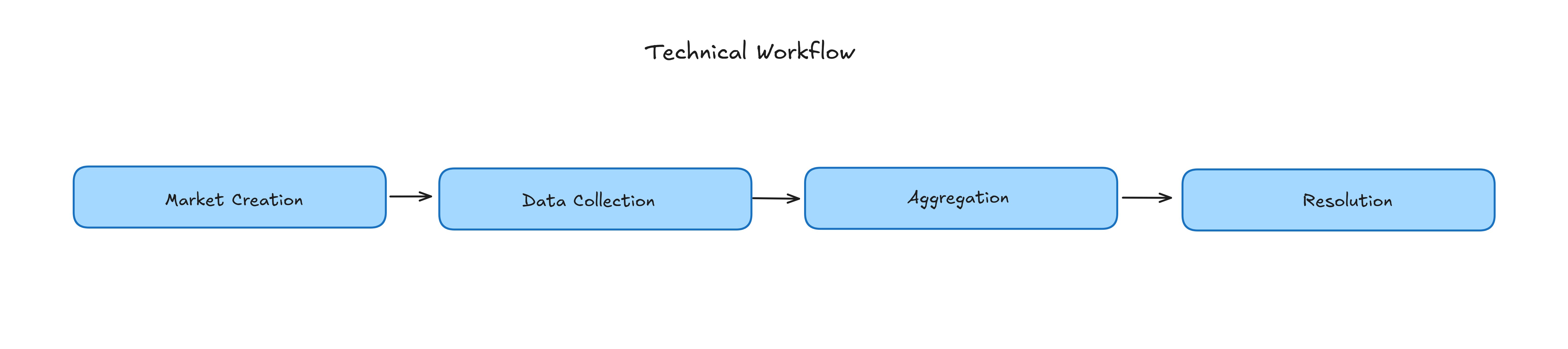
This type of prediction market relies on expert or community consensus to determine event outcomes, often using judgmental aggregation algorithms like the Delphi method. This approach is suited for subjective or ambiguous events (e.g., “Will AI surpass human intelligence by 2030?”) where automated data is unavailable or unreliable. Platforms collect votes or opinions from designated reviewers, aggregate them (e.g., via weighted majority or Bayesian methods), and resolve the market. In decentralized systems, this may involve staking or incentives to ensure honest reporting.
The Delphi method uses iterative consensus building:
ConsensusLevel = 1 - (σ / μ)
Where:
σ = standard deviation of expert opinions
μ = mean of expert opinions
Real-World Examples
SAP Analytics Cloud (Delphi-Method Tools): While not a traditional prediction market, it uses human-reviewed forecasting with Delphi-style consensus for business predictions (e.g., sales forecasts). Experts iteratively refine predictions off-chain, aggregated centrally for resolution.
Manifold Markets: A semi-decentralized platform for community-driven predictions, using human moderators (trusted reveiwers) to resolve niche markets (e.g., cultural events).
SWOT Analysis
Strengths:
Handles Ambiguity: Excels for subjective or complex events where automated feeds fail.
Robustness: Human judgment can correct errors in data sources, unlike oracle-based systems (e.g., detecting API manipulation).
Community Engagement: In decentralized systems, staking incentivizes participation and honest reporting.
Flexibility: Adaptable to diverse market types, from cultural to scientific outcomes, without requiring structured data.
Trust Building: Expert-driven platforms leverage domain knowledge, enhancing credibility.
Weaknesses:
Subjectivity: Human judgment introduces bias or disagreement, potentially leading to disputes (e.g., ambiguous event definitions).
Latency: Voting or consensus processes are slower than automated systems, delaying payouts.
Cost: In decentralized systems, staking or incentives increase user costs; centralized systems require paid experts.
Scalability Limits: Human review doesn’t scale well for high-frequency markets due to manual effort.
Manipulation Risk: Collusion among voters or experts can skew outcomes, especially in low-participation markets.
Opportunities:
AI-Augmented Review: Combining human input with AI (e.g., sentiment analysis) could improve accuracy and speed.
Niche Markets: Expanding to subjective domains (e.g., art valuations, policy impacts) could attract specialized audiences.
Decentralized Governance: DAOs could enhance human-reviewed systems, as in Gnosis, by incentivizing broader participation.
Hybrid Integration: Pairing with automated feeds could reduce latency while retaining human oversight.
Educational Use: Platforms like SAP could expand into academic or corporate forecasting, leveraging expert consensus.
Threats:
Regulatory Barriers: Subjective markets may face scrutiny for gambling-like qualities, especially in the U.S.
Low Participation: Decentralized platforms risk insufficient voter turnout, leading to unreliable resolutions
Bias Exposure: Public backlash over perceived bias could undermine trust.
Competition from Automation: Faster oracle or feed-based systems (e.g., Polymarket) may outpace human-reviewed platforms.
Cost Pressures: High operational costs for expert hiring or staking could make platforms less competitive.
3. Automated Feed-Based Resolution
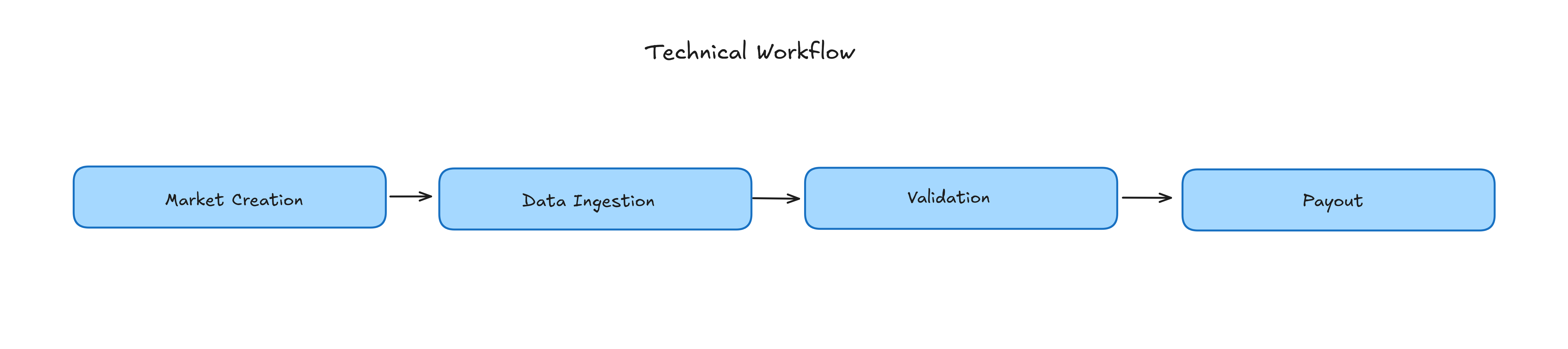
Automated feed-based resolution pulls data directly from real-time APIs, sensors, or external feeds (e.g., financial market APIs, IoT devices) to resolve market outcomes. These systems are designed for speed and scalability, ideal for events with structured, machine-readable data (e.g., stock prices, weather metrics). The platform ingests data via automated scripts or integrations, processes it, and resolves the market without human intervention. However, they are prone to errors if the feed is inaccurate or manipulated.
Real-World Examples
Numerai: A hedge fund platform using prediction markets for ML model performance, resolving outcomes via stock market APIs.
Oracle Analytics Cloud: A business intelligence tool with prediction market-like features, using automated data ingest from APIs (e.g., economic indicators) for forecasting. It relies on real-time feeds for rapid resolution in enterprise settings.
Bet365 (In-Play Markets): A centralized betting platform using API feeds for live sports outcomes.
SWOT Analysis
Strengths:
High Speed: Real-time API feeds enable near-instant resolution, ideal for dynamic markets.
Scalability: Handles high-frequency, structured datawith minimal human overhead.
Cost Efficiency: No staking or oracle fees, unlike blockchain-based systems; centralized platforms optimize infrastructure.
Reliability for Structured Data: Excels for events with clear, machine-readable outcomes (e.g., financial prices, weather).
Broad Integration: APIs connect to diverse sources enabling versatile markets.
Weaknesses:
Feed Vulnerability: Errors or manipulation in APIs (e.g., hacked financial feeds) can lead to incorrect resolutions.
Centralization: Most platforms are centralized, lacking blockchain’s transparency and trustlessness.
Limited Scope: Only works for events with reliable APIs, excluding subjective or niche outcomes (e.g., cultural events).
Maintenance Overhead: Managing API integrations requires constant updates and error handling.
Data Latency: Even minor API delays can disrupt real-time markets, impacting user experience.
Opportunities:
IoT Integration: Sensors could expand markets to physical events, enhancing Oracle Analytics’ scope.
AI Validation: Machine learning could detect feed anomalies, improving reliability.
Cross-Platform APIs: Standardized APIs could enable interoperability across platforms, boosting liquidity.
Emerging Markets: Expanding to real-time domains (e.g., esports, live streaming metrics) could attract younger users.
Hybridization: Combining with human review could add robustness for edge cases, bridging to hybrid models.
Threats:
API Failures: Downtime or manipulation of data sources could erode trust.
Regulatory Constraints: Centralized platforms face strict rules limiting market types.
Competition from Oracles: Decentralized oracle systems offer similar speed with blockchain transparency, challenging centralized feeds.
Cybersecurity Risks: API breaches or DDoS attacks could disrupt resolutions, especially for high-stakes markets.
User Trust: The lack of transparency in centralized feed processing may deter users from favoring blockchain solutions.
4. Hybrid Resolution
Hybrid resolution markets combines automated data feeds (e.g., oracles, APIs) with human review or dispute mechanisms to balance speed, accuracy, and robustness. Typically, an automated system provides an initial outcome, which can be challenged by human validators (e.g., community voters, experts) if disputes arise. This is common in decentralized platforms where oracles supply data, but human oversight ensures fairness for ambiguous or contested outcomes. The process leverages smart contracts for automation and on-chain governance for disputes.

Real-World Examples
Augur (Turbo): Uses Chainlink oracles for initial outcomes (e.g., sports results) but allows community disputes with staked voting on Ethereum. Fit: Combines automated speed with human oversight for contested markets.
Reality.eth: A decentralized platform for prediction markets, using oracles for initial data and Kleros-style human arbitration for disputes.
Polkamarkets: Built on Polkadot, it uses oracles for primary resolution (e.g., price feeds) but incorporates community governance for disputes. It balances scalability and fairness for diverse markets.
Trepa: A decentralized platform for scalar predictions using oracles to resolve outcomes. These oracles automatically pull numerical data to resolve forecasts, minimizing human intervention and bias. However, in cases where oracle data might be ambiguous or unavailable, trepa employs manual verification by trusted sources or community consensus to confirm outcomes, ensuring fairness.
SWOT Analysis
Strengths:
Balanced Approach: Combines automated speed (oracles/APIs) with human robustness, handling both objective and ambiguous events.
Dispute Resolution: Human oversight corrects oracle errors or manipulations, enhancing trust.
Scalability: Off-chain or oracle components reduce on-chain costs, while blockchain ensures transparent payouts.
Flexibility: Supports diverse markets, from financial to subjective, by leveraging both data feeds and human judgment.
Community Incentives: Staking in disputes aligns validator interests with accuracy.
Weaknesses:
Complexity: Combining automated and human systems increases technical and operational overhead.
Latency in Disputes: Human review slows resolution for contested outcomes, delaying payouts.
Partial Trust: Relies on oracle reliability and honest human validators, introducing trust points compared to fully on-chain systems.
Cost: Oracle fees and staking for disputes add costs, especially on Ethereum-based platforms like Augur.
Low Dispute Participation: Insufficient validator turnout can weaken dispute resolution.
Opportunities:
Advanced Oracles: Improved oracle protocols could enhance initial data reliability, reducing disputes.
AI Assistance: Machine learning could pre-filter disputes, streamlining human review.
Cross-Chain Expansion: Platforms like Polkamarkets could leverage Polkadot’s interoperability for broader market access.
User Growth: Simplified UX for disputes could attract non-crypto users, bridging to mainstream adoption.
Regulatory Adaptation: Hybrid models could align with regulations by formalizing human oversight, competing with centralized platforms.
Threats:
Regulatory Risks: Operating in gray areas could attract CFTC or global scrutiny.
Oracle Vulnerabilities: Data feed failures or attacks could trigger disputes, straining human resolution.
Competition: Fully automated platforms offer speed, while human-reviewed systems excel in subjectivity, challenging hybrids.
Validator Collusion: Malicious actors could manipulate dispute outcomes, especially in low-stake markets.
Cost Pressures: Rising blockchain or oracle costs could make hybrids less competitive against fully off-chain platforms.
Trade-Offs and Considerations
Oracle-Based: Fast and scalable but vulnerable to data source failures. Best for structured, API-accessible events.
Human-Reviewed: Robust for subjective outcomes but slow and subjective. Ideal for complex or niche markets.
Automated Feed-Based: High-speed and cost-effective for structured data but lacks transparency and error correction. Suited for centralized, high-frequency markets.
Hybrid Resolution: Balances speed and accuracy but introduces complexity and partial trust. Versatile for diverse markets.
#3 Technical Infrastructure and Deployment
This is the underlying architecture of prediction market platforms, determining how they handle operations like market creation, trading, resolution, and settlements. This typology is crucial for balancing decentralization, scalability, cost, and reliability. Platforms are categorized into Fully On-Chain (all operations executed via blockchain smart contracts for maximum transparency), Fully Off-Chain (centralized systems using proprietary servers for efficiency and compliance), and Hybrid (a blend of on-chain and off-chain elements for optimized performance). This section explains each category's mechanics, highlights protocol examples, and provides a SWOT analysis emphasizing technical implications.
1. Fully On-Chain Infrastructure and Deployment
Fully on-chain platforms execute all core functions like market creation, order matching, trading, resolution, and payouts directly through blockchain smart contracts, without relying on external off-chain components like oracles or centralized servers. Users interact via wallets (e.g., MetaMask), and all data is stored immutably on the blockchain. Market creation involves deploying a smart contract defining the event (e.g., binary or scalar outcomes) and parameters (e.g., collateral token). Trading uses automated market makers (AMMs) or order books encoded in contracts, where liquidity is provided by staked tokens. Resolution occurs via on-chain governance (e.g., community voting encoded in the contract) or predefined logic (e.g., comparing to native blockchain data like token prices). Payouts are automatic upon resolution, redistributing collateral to winners.
Platform Examples
Opinion Labs (O.LAB): O.LAB enables permissionless market creation for events like economic indicators or crypto trends, using on-chain optimistic oracles for resolution. All operation are fully on-chain, from market deployment to voting-based settlements, are handled by smart contracts, with no external data feeds.
Ruckus Market: Deployed on HeLa Chain (a modular blockchain for gaming and predictions), it focuses on entertainment and sports outcomes with immutable on-chain ledgers. Its entirely on-chain, leveraging HeLa's smart contracts for trading and resolution via community staking, without off-chain dependencies.
Ventuals: Emerged in late 2024 on a custom EVM chain, specializing in equity derivatives for unlisted companies (e.g., predicting OpenAI valuations). It's fully on-chain with smart contracts managing leveraged trades (up to 10x) and resolutions via on-chain consensus, ensuring transparency for high-stakes forecasts.
SWOT Analysis
Strengths:
Inherent Transparency: All operations recorded on a public blockchain ensure verifiable, tamper-proof data, fostering trust without intermediaries.
Decentralization: Eliminates central points of failure, enabling global, permissionless access and resilience against censorship or shutdowns.
Programmable Flexibility: Smart contracts support customizable markets (e.g., binary, scalar) and automated payouts, enhancing innovation.
Immutable Security: Blockchain’s cryptographic guarantees protect funds and outcomes, reducing manipulation risks.
DeFi Compatibility: Native integration with token ecosystems enables staking, lending, or liquidity pools, amplifying market depth.
Weaknesses:
High Computational Costs: On-chain execution (e.g., gas fees for trading) increases expenses, especially on congested networks like Ethereum, limiting micro-transactions.
Scalability Constraints: Blockchain throughput caps (even on fast chains like Solana) cause delays during high-volume events, impacting real-time trading.
Limited Data Scope: Restricted to on-chain verifiable data (e.g., crypto prices) or slow governance-based resolution, excluding complex real-world events.
Technical Complexity: Requires robust smart contract design and user familiarity with wallets, increasing development and onboarding barriers.
Network Dependency: Susceptible to blockchain-specific issues like congestion, upgrades, or forks, disrupting operations.
Opportunities:
High-Throughput Blockchains: Emerging Layer 1s (e.g., with 10,000+ TPS) could reduce costs and latency, enabling mass adoption.
Advanced Governance Models: On-chain DAOs or AI-driven voting could streamline resolutions, expanding market types to subjective events.
Cross-Chain Interoperability: Protocols like Polkadot could unify liquidity across chains, boosting scalability.
Institutional DeFi Growth: Integration with tokenized assets could attract hedge funds, driving TVL growth to $10B+ by 2030.
Developer Ecosystems: Open-source smart contract frameworks could lower barriers, fostering new market innovations.
Threats:
Regulatory Uncertainty: Global restrictions on decentralized platforms could limit access or impose compliance costs.
Smart Contract Vulnerabilities: Bugs or exploits in contract code risk fund losses, eroding user trust.
Scalability Competition: Off-chain and hybrid systems offer faster, cheaper alternatives, potentially capturing market share.
User Adoption Barriers: Crypto volatility and UX complexity may deter mainstream users, capping growth at 15-20% of the market.
Network Instability: Chain-specific risks (e.g., 51% attacks, downtime) could disrupt critical operations, reducing reliability.
2. Fully Off-Chain Infrastructure and Deployment
Fully off-chain platforms rely on centralized servers and databases to manage all operations including, market creation, trading, order matching, resolution, and payouts without blockchain involvement. Users access platforms via web or mobile apps, funding accounts with fiat (e.g., USD via bank transfers). Market creation is admin-driven or algorithmic, defining events and odds in a database. Trading uses centralized order books for real-time matching, with liquidity often house-backed or user-pooled. Resolution involves internal verification, pulling data from trusted APIs (e.g., sports feeds, election results) or manual checks. Payouts are processed via payment gateways (e.g., Stripe). This model prioritizes speed, low costs, and regulatory compliance but risks single-point failures and lacks transparency. Security relies on encryption and audits, with cloud infrastructure enabling high scalability.
Examples
Novig: A Fully off-chain platform, using centralized servers for trading and API-based resolution, ensuring CFTC compliance with fiat settlements.
ForecastEx: Gained prominence in 2025 via Nasdaq partnerships for economic forecasts (e.g., S&P 500). Fit: Centralized off-chain infrastructure with internal APIs and fiat payouts, designed for institutional-grade transparency.
Crypto.com Prediction Markets: Expanded in 2025 to 16 U.S. states for sports events, integrated into its centralized exchange. Fit: Fully off-chain with server-based order matching and licensed data providers, supporting fiat/crypto but no blockchain for core operations.
SWOT Analysis
Strengths:
High Performance: Centralized servers deliver sub-second order matching and resolution, ideal for real-time markets like live sports or elections.
Cost Efficiency: No blockchain fees reduce transaction costs, enabling low commissions (e.g., 1-2%) and micro-betting support.
Scalability: Cloud infrastructure handles millions of transactions, supporting high-volume events without latency issues.
Regulatory Alignment: Easier compliance with financial regulations (e.g., CFTC, AML) via centralized control, enabling fiat integration and legal operation.
User Accessibility: Web-based interfaces and fiat payments simplify onboarding for non-technical users, broadening market reach.
Weaknesses:
Centralization Risks: Single points of failure (e.g., server outages, hacks) threaten reliability, with no decentralized fallback.
Opacity: Internal data handling lacks public verifiability, requiring trust in the operator for fair resolutions and payouts.
Censorship Vulnerability: Subject to regulatory or corporate shutdowns, limiting global access in restrictive regions.
Limited Innovation: Relies on traditional tech stacks, slower to adopt DeFi-like features (e.g., token staking, AMMs).
Data Security Concerns: Centralized databases are prime targets for breaches, risking user funds and privacy.
Opportunities:
Cloud Advancements: Next-gen cloud solutions (e.g., AWS Graviton) could enhance scalability, handling 10x transaction spikes by 2026.
Regulatory Expansion: Easing of CFTC rules post-2025 could allow broader market types (e.g., climate, entertainment), boosting adoption.
FinTech Integration: Partnerships with payment gateways could streamline fiat transactions, targeting 100 million users.
AI Optimization: Centralized AI could improve odds calculation and user personalization, enhancing engagement.
Global Market Entry: Licensing in new regions (e.g., Asia-Pacific) could drive 50% volume growth with regulatory clarity.
Threats:
Cybersecurity Risks: Data breaches or DDoS attacks could disrupt operations and erode trust, especially during high-stakes events.
Regulatory Restrictions: Tightening laws (e.g., state-level bans in the U.S.) could limit market scope or force closures.
Competition from Blockchain: On-chain and hybrid platforms offer transparency and censorship resistance, attracting crypto-savvy users.
Trust Deficits: Perceived manipulation or payout delays could drive users to decentralized alternatives.
Technological Stagnation: Failure to adopt emerging tech (e.g., AI-driven resolutions) could cede ground to innovative rivals.
3. Hybrid Infrastructure and Deployment
Hybrid platforms combine on-chain elements (e.g., smart contracts for settlements, tokenization) with off-chain components (e.g., oracles for data, centralized order books for matching) to balance decentralization with efficiency. On-chain operations, typically on Layer 2 chains, handle trustless tasks like collateral locking and payouts. Off-chain systems manage high-latency tasks, such as order matching via centralized APIs or data fetching via oracles. Market creation may start with an off-chain UI but deploys a smart contract. Trading uses off-chain signed orders (e.g., EIP-712) for speed, batched on-chain for settlement.
Platform Examples
Limitless: Beta-launched in 2024 on Base, with $300 million+ volume by mid-2025, using CLOB for liquidity-trained predictions, with on-chain Base settlements and off-chain APIs/oracles for data, plus centralized UI for accessibility.
Gensyn Judge: Unveiled in September 2025 on a custom chain, using AI for scalable resolutions, with on-chain contracts and off-chain AI/oracles for objective dispute handling, blending speed and decentralization.
PredX: A multi-chain platform with Telegram mini-apps for AI-assisted predictions. Does on-chain executions and off-chain AI/data feeds, enhancing UX with social integration.
SWOT Analysis
Strengths:
Balanced Efficiency: Off-chain components (e.g., order matching) provide low-latency trading, while on-chain settlements ensure trustless payouts.
Broad Event Support: Oracles enable real-world data integration (e.g., sports, elections), expanding beyond on-chain-only limits.
Cost Optimization: Layer 2 chains reduce gas fees by up to 90%, making frequent transactions viable for retail users.
Enhanced UX: Centralized UIs lower onboarding barriers, bridging Web2 and Web3 audiences without sacrificing partial decentralization.
Scalable Architecture: Off-chain processing handles high volumes, while blockchain ensures auditability, supporting dynamic markets.
Weaknesses:
Partial Trust Requirements: Reliance on oracles or off-chain servers introduces vulnerabilities (e.g., data manipulation, API downtime).
Increased Complexity: Managing dual systems (on/off-chain) raises development and maintenance costs, risking bugs or integration failures.
Fragmented Security: Combines blockchain risks (e.g., contract exploits) with centralized risks like server hacks, expanding attack surfaces.
Regulatory Ambiguity: Hybrid models face scrutiny for blending regulated (off-chain) and unregulated (on-chain) elements, complicating compliance.
Interoperability Issues: Multi-chain setups or oracle integrations may face latency or bridging errors, disrupting operations.
Opportunities:
Advanced Oracle Solutions: Next-gen oracles (e.g., Chainlink CCIP) could improve data reliability, enabling broader market types by 2026.
AI Integration: Off-chain AI for market analysis or resolution could enhance scalability, targeting $1B TVL in hybrid markets.
Layer 2 Growth: Expanding L2 adoption (e.g., Base, Arbitrum) could cut costs further, driving 50% user growth.
Social and Mobile UX: Off-chain apps (e.g., Telegram integration) could onboard millions, leveraging 2025’s Web3 social trends.
Regulatory Harmonization: Post-2025 CFTC clarity could legitimize hybrids, opening U.S. markets with compliant oracle frameworks.
Threats:
Oracle Vulnerabilities: Data inaccuracies or attacks (e.g., 2025 oracle hacks) could undermine resolution trust, disrupting markets.
Regulatory Crackdowns: Stricter laws (e.g., EU AI regulations, CFTC gambling rules) could limit hybrid operations or impose fines.
Pure System Competition: Fully on-chain platforms offer total decentralization, while off-chain systems provide speed, fragmenting hybrid market share.
Technical Failures: Integration bugs (e.g., oracle-chain mismatches) could delay resolutions or cause fund losses.
Market Volatility: Crypto price swings impact on-chain collateral, reducing hybrid platform stability in bear markets.
Trade-Offs and Considerations
Fully On-Chain: Offers unmatched transparency and censorship resistance but struggles with costs and scalability, limiting it to blockchain-native events.
Fully Off-Chain: Prioritizes speed and compliance for mainstream adoption but sacrifices decentralization and trust, relying on operator integrity.
Hybrid: Balances performance and decentralization, covering diverse events via oracles, but introduces complexity and partial trust dependencies.
#4 Incentive Structures and Liquidity Models
Incentive structures are critical to prediction markets, as they drive user participation and ensure truthful reporting to produce accurate forecasts. These mechanisms align participant interests with market goals, rewarding accurate predictions and penalizing errors. This section classifies incentive structures into five categories: Market-Maker Model (Automated Market Makers), Order-Book Model, Token Staking, Scoring-Based, and Participation Rewards. Each leverages distinct motivators, liquidity provision, trading efficiency, reputation, algorithmic scoring, or activity-based incentives to encourage engagement.
1. Market-Maker Model (Automated Market Makers)
The Market-Maker Model uses Automated Market Makers (AMMs) to incentivize participation by enabling users to provide liquidity to prediction markets via smart contracts, typically on decentralized platforms. AMMs replace traditional order books with liquidity pools, where users deposit tokens (e.g., USDC, ETH) to fund trading for outcomes (e.g., “Yes” or “No” shares). The pool’s pricing algorithm, often a constant product formula (e.g., x⋅y = k), adjusts share prices based on supply and demand, ensuring continuous liquidity. Participants earn fees (e.g., 1-2% of trades) proportional to their pool contributions, incentivizing liquidity provision and accurate pricing. AMMs operate on-chain, with smart contracts handling deposits, trades, and payouts, ensuring trustless execution. The model encourages participation by rewarding liquidity providers while facilitating trading, though it requires high initial capital and can suffer from impermanent loss.
Mathematical Formula (AMM Pricing):
For a binary market with pools for “Yes” ( x )and “No” ( y ) outcomes, the constant product AMM maintains:
The price of a “Yes” share is:
Liquidity providers earn fees:
Code Example (Solidity for AMM Market):
// SPDX-License-Identifier: MIT
pragma solidity ^0.8.0;

contract AMMPredictionMarket {
    uint256 public yesPool;
    uint256 public noPool;
    uint256 public constant K = 1000000; // Constant product
    mapping(address => uint256) public liquidity;

    function addLiquidity() public payable {
        require(msg.value > 0, "No funds provided");
        uint256 yesShare = msg.value / 2;
        uint256 noShare = msg.value / 2;
        yesPool += yesShare;
        noPool += noShare;
        liquidity[msg.sender] += msg.value;
    }

    function buyShares(bool _yes, uint256 _amount) public payable {
        require(msg.value > 0, "No funds provided");
        if (_yes) {
            uint256 newYesPool = yesPool + _amount;
            uint256 newNoPool = (K * yesPool * noPool) / newYesPool;
            noPool = newNoPool;
            yesPool = newYesPool;
        } else {
            uint256 newNoPool = noPool + _amount;
            uint256 newYesPool = (K * yesPool * noPool) / newNoPool;
            yesPool = newYesPool;
            noPool = newNoPool;
        }
    }

    function getPrice(bool _yes) public view returns (uint256) {
        return _yes ? (noPool * 100) / (yesPool + noPool) : (yesPool * 100) / (yesPool + noPool);
    }
}
This contract implements an AMM for a binary market, adjusting prices based on pool balances.
Platform Examples
Azuro Protocol: Azuro uses AMMs for sports and crypto price predictions. Liquidity providers deposit USDC into pools, earning 2% fees on trades, with smart contracts managing all operations on-chain, aligning with the AMM model’s decentralized, liquidity-driven incentives.
Moonopol: Moonopol uses AMMs to incentivize liquidity provision. Its low-fee pools attract DeFi users, with on-chain contracts ensuring trustless rewards.
SWOT Analysis
Strengths:
Continuous Liquidity: AMMs ensure markets are always tradable, eliminating order book gaps and encouraging participation.
Decentralized Incentives: On-chain fee distribution via smart contracts ensures trustless rewards for liquidity providers.
Automated Pricing: Algorithmic price adjustments (e.g., constant product) align market odds with user stakes, enhancing accuracy.
Scalability for DeFi: Integrates seamlessly with token ecosystems, supporting high-frequency trading on fast chains.
Low Maintenance: No need for manual market-making, reducing operational overhead compared to order books.
Weaknesses:
High Capital Requirements: Liquidity provision demands significant upfront deposits, deterring small-scale participants.
Impermanent Loss: Price shifts in pools can reduce provider returns, discouraging long-term commitment.
On-Chain Costs: High gas fees on congested blockchains increase trading and liquidity provision expenses.
Complexity: AMM mechanics (e.g., constant product curves) are less intuitive for non-technical users, limiting mainstream adoption.
Slippage Risks: Large trades in small pools cause price volatility, impacting trading efficiency.
Opportunities:
Layer 2 Scaling: Low-cost L2 chains (e.g., Base) could reduce fees, attracting more liquidity providers by 2026.
Advanced AMM Algorithms: Improved formulas (e.g., dynamic curves) could minimize impermanent loss, boosting participation.
DeFi Integration: Pairing with staking or lending protocols could amplify rewards, targeting $500M TVL.
Cross-Chain Liquidity: Interoperable pools could unify markets across blockchains, enhancing depth.
User Education: Simplified UX for AMMs could onboard retail users, expanding market reach.
Threats:
Regulatory Scrutiny: Decentralized AMMs may face bans as unregistered securities or gambling platforms.
Smart Contract Risks: Bugs or exploits in AMM contracts could lead to fund losses, eroding trust.
Competition from Order Books: Traditional exchanges offer tighter spreads, attracting high-frequency traders.
Market Volatility: Crypto price swings reduce pool stability, impacting provider confidence.
Low Liquidity Risks: Underfunded pools lead to high slippage, deterring traders and providers.
2. Order-Book Model
The Order-Book Model incentivizes participation through traditional exchange mechanics, where users place buy and sell orders for outcome shares ( say “Yes” at $0.60) on a centralized or decentralized order book. Orders are matched based on price and volume, with liquidity provided by user bids/asks or house-backed pools. Participants are motivated by potential profits from trading at favorable prices, akin to stock exchanges. Centralized platforms manage order books via servers, offering low-latency matching and fiat integration. Decentralized platforms use on-chain or hybrid order books, with settlements via smart contracts.
Platform Examples
Novig: Novig uses a centralized order book for sports and political betting. Its server-based matching ensures sub-second trades, incentivizing users with tight spreads and fiat payouts, making it a leading off-chain exchange model.
Betfair Exchange: A long-standing platform, prominent in 2025 for its $2 billion+ sports betting volume, Betfair operates a centralized order book.
PredX: PredX uses a hybrid order book with off-chain matching and on-chain settlements.
SWOT Analysis
Strengths:
Trading Efficiency: Precise bid/ask matching ensures tight spreads, rewarding strategic traders with profit opportunities.
High Liquidity Potential: Large order books attract market makers, ensuring robust markets for popular events.
User Control: Traders set their own prices, incentivizing active participation and price discovery.
Scalability in Centralized Systems: Server-based order books handle millions of trades with minimal latency.
Market Depth: Supports complex strategies (e.g., limit orders), appealing to professional traders.
Weaknesses:
Liquidity Dependence: Thin order books in niche markets lead to wide spreads, discouraging participation.
Centralization Risks: Off-chain order books require trust in operators, with risks of manipulation or outages.
High Maintenance: Order matching requires robust infrastructure, increasing operational costs.
Complexity for Novices: Order book mechanics are less intuitive than AMMs, deterring casual users.
On-Chain Latency: Decentralized order books face blockchain delays, reducing efficiency compared to centralized systems.
Opportunities:
Hybrid Advancements: Combining off-chain matching with on-chain settlements could reduce costs and enhance trust.
AI-Driven Matching: AI could optimize order pairing, improving liquidity and user experience by 2026.
Fiat Integration: Partnerships with payment gateways could mainstream centralized order books, targeting 50 million users.
Global Expansion: Regulatory clarity could open new markets, boosting order book liquidity.
Mobile UX: Streamlined apps could attract retail traders, expanding adoption.
Threats:
Regulatory Barriers: Centralized order books face strict gambling or financial regulations, limiting scope.
Competition from AMMs: Decentralized AMMs offer continuous liquidity, drawing DeFi users away.
Cybersecurity Risks: Centralized servers are hack targets, risking user funds and trust.
Market Fragmentation: Multiple exchanges split liquidity, reducing efficiency in smaller markets.
Economic Downturns: Reduced trading volumes in bear markets thin order books, impacting profitability.
3. Token Staking
Token Staking incentivises participation by requiring users to lock tokens (e.g., governance or reputation tokens) to participate in markets or resolve outcomes, rewarding truthful reporting with token returns or additional rewards. In decentralised platforms, users stake tokens to place bets, vote on resolutions, or act as market creators, with stakes slashed for dishonest behaviour (e.g., incorrect votes). This aligns incentives with accuracy, as users risk losing tokens. Rewards may include governance rights, fees, or token appreciation. Staking is managed via smart contracts, with on-chain logic tracking stakes and payouts. The model fosters trust and engagement but requires token ecosystems and can be deterred by volatility.
Mathematical Formula (Staking Reward):
If incorrect, the stake is slashed:
Platform Examples
Gensyn Judge: Unveiled in 2025 on a custom chain, it uses AI and token staking for scalable prediction resolutions. Users stake $GEN tokens to vote on outcomes, earning governance rights and fees.
Polkamarkets: A prediction market on Polkadot, it uses POLK tokens for staking in event markets. Participants stake for trading and resolution and are rewarded with fees.
SWOT Analysis
Strengths:
Strong Alignment: Staking ties financial risk to accuracy, ensuring truthful reporting and resolution.
Decentralized Governance: Token holders influence market rules, enhancing community trust and engagement.
Flexible Rewards: Combines financial (fees) and non-financial (governance) incentives, appealing to diverse users.
Blockchain Security: On-chain staking ensures transparent, tamper-proof reward distribution.
Scalable Engagement: Token ecosystems support large-scale participation in DeFi markets.
Weaknesses:
Token Volatility: Fluctuating token prices (e.g., 2025 crypto dips) reduce reward predictability, deterring users.
High Entry Costs: Staking requires significant token holdings, excluding low-capital participants.
Complexity: Blockchain-based staking demands technical knowledge, limiting mainstream adoption.
Slashing Risks: Incorrect predictions or votes lead to losses, discouraging risk-averse users.
Liquidity Dependence: Low token liquidity can destabilize markets, reducing incentive effectiveness.
Opportunities:
Stablecoin Staking: Using stable tokens could mitigate volatility, attracting retail users.
Cross-Chain Growth: Interoperable staking (e.g., via Polkadot) could unify liquidity, boosting participation.
AI Governance: AI-driven staking rules could streamline resolutions, targeting $200M TVL by 2026.
Regulatory Clarity: Post-2025 CFTC rules could legitimize staking models, opening U.S. markets.
Community Incentives: Governance tokens could enhance user retention through voting rights.
Threats:
Regulatory Bans: Staking may be classified as unregistered securities, facing global restrictions.
Market Crashes: Token value drops reduce staking incentives, impacting market depth.
Competition: Non-staking models (e.g., AMMs, order books) offer simpler incentives, drawing users away.
Security Risks: Smart contract exploits could lead to stake losses, eroding trust.
Low Participation: Insufficient staking in niche markets weakens resolution accuracy.
4. Scoring-Based
Scoring-Based incentive structures reward users with points or leaderboard rankings based on prediction accuracy, often using algorithmic metrics like the Brier score. Participants submit forecasts (e.g., probability for an outcome), and scores are calculated post-resolution, with higher scores for accurate predictions. Points may translate to reputation, badges, or minor financial rewards in hybrid systems. Centralized platforms use databases to track scores, while decentralized ones use smart contracts. This model encourages skillful forecasting without direct financial risk, ideal for educational or community-driven platforms, but may lack strong incentives for high-stakes markets.
Mathematical Formula (Brier Score):
For ( N ) predictions, with forecast probability fi and outcome oi (1 or 0), the Brier score is:
Reward points are:
Platform Examples
Metaculus: A community-driven platform, prominent in 2025 for scalar and binary predictions (e.g., AI milestones), uses points and leaderboards to reward accuracy. Its scoring system incentivizes skillful forecasting, attracting thousands of users for non-financial engagement.
Good Judgment Open: A long-standing platform that awards points for accurate crowd-sourced predictions. Its leaderboard-driven model fosters competition, aligning with scoring-based incentives for educational purposes.
Cultivate Forecasts: Gaining traction in 2025 for corporate predictions, it uses scoring to reward employee forecasts (e.g., sales projections). Points drive internal engagement, making it a prominent non-monetary model in enterprise settings.
SWOT Analysis
Strengths:
Low Financial Risk: Points-based rewards eliminate monetary stakes, attracting risk-averse users.
Broad Accessibility: Simple scoring encourages participation from diverse, non-technical audiences.
Educational Value: Ideal for research or training, fostering skill development without financial loss.
Scalable Engagement: Low-cost point systems support large user bases with minimal overhead.
Gamification Appeal: Leaderboards and badges drive competitive participation, enhancing retention.
Weaknesses:
Weak Incentives: Non-financial rewards may fail to motivate rigorous forecasting, reducing accuracy.
Subjectivity Risks: Scoring disputes (e.g., ambiguous outcomes) can frustrate users, lacking financial stakes to enforce discipline.
Limited Liquidity: Points don’t contribute to market depth, unlike monetary systems.
Centralization Dependency: Most scoring systems rely on trusted operators, risking bias or manipulation.
Engagement Volatility: Lack of tangible rewards may lead to user dropout over time.
Opportunities:
AI-Enhanced Scoring: Advanced metrics (e.g., logarithmic scoring) could improve accuracy and fairness.
Hybrid Rewards: Combining points with tokens could bridge to financial incentives, boosting engagement.
Corporate Adoption: Scoring systems could expand into business forecasting, targeting enterprise markets.
Social Integration: Leaderboards in social platforms could attract younger users, driving adoption.
Global Reach: Regulatory safety allows scoring-based platforms to operate in restrictive regions.
Threats:
Competition from Financial Models: Monetary incentives offer stronger motivation, drawing users away.
Trust Issues: Perceived bias in scoring or leaderboards could erode credibility.
Engagement Decline: Lack of financial stakes may reduce long-term participation, especially in high-stakes markets.
Regulatory Ambiguity: Some regions may classify scoring as gambling, imposing restrictions.
Scalability Limits: High user volumes require robust scoring systems, risking technical failures.
5. Participation Rewards
Participation Rewards incentivize users through activity-based benefits, such as tokens, points, or perks for actions like placing predictions, creating markets, or sharing insights, regardless of accuracy. This model encourages frequent engagement, especially in early-stage platforms, to build user bases and liquidity. In decentralized systems, rewards are distributed via smart contracts, often tied to native tokens. Centralized platforms use databases to track activities and award points or discounts. Rewards may include governance rights, reduced fees, or social recognition.
Platform Examples
Myriad Markets: Launched in late 2024, Myriad rewards users with tokens for creating markets or sharing forecasts on platforms like Telegram.
ForecastEx: Prominent in 2025 via Nasdaq partnerships for economic predictions, it rewards users with platform credits for frequent forecasting.
Ruckus Market: A platform offers tokens for market creation and social sharing.
SWOT Analysis
Strengths:
Broad Engagement: Rewards for activities like market creation or sharing attract diverse users, boosting platform activity.
Low Barrier to Entry: Non-accuracy-based rewards encourage participation from novices, expanding user bases.
Community Building: Social or governance perks foster loyalty, enhancing platform ecosystems.
Flexible Implementation: Works in both centralized (databases) and decentralized (smart contracts) systems, supporting scalability.
Early-Stage Growth: Drives initial adoption in new markets, building liquidity rapidly.
Weaknesses:
Low Accuracy Incentive: Rewarding activity over accuracy risks low-quality predictions, undermining market reliability.
Reward Dilution: Over-issuance of points or tokens can devalue incentives, reducing motivation.
Spam Vulnerability: Non-rigorous rewards may encourage gaming or low-effort participation, clogging systems.
Complexity in Design: Balancing reward distribution requires careful tuning to avoid exploitation.
Centralization Risks: Centralized reward systems lack transparency, risking user distrust.
Opportunities:
Social Media Integration: Activity rewards on platforms like Telegram could drive viral adoption, targeting millions of users.
Token Ecosystem Growth: Decentralized rewards could integrate with DeFi, enhancing value and retention.
AI Personalization: AI could tailor rewards to user behavior, improving engagement by 2026.
Corporate Use: Activity-based incentives could expand into employee forecasting, boosting enterprise adoption.
Regulatory Safety: Non-financial rewards avoid gambling laws, enabling global reach.
Threats:
Competition from Stronger Incentives: Monetary or scoring-based models offer more compelling motivation, drawing users away.
Reward Inflation: Over-rewarding could crash token or point value, reducing effectiveness.
Regulatory Scrutiny: Activity rewards may still face gambling classifications in some regions.
User Fatigue: Excessive reward schemes could lead to disengagement if perceived as gimmicky.
Technical Overload: High activity volumes strain centralized or on-chain systems, risking failures.
Conclusion
Prediction markets in 2025 stand at an inflection point, no longer niche experiments, but emerging as credible tools for information aggregation, hedging, and collective intelligence.
The future of prediction markets will likely be defined by three converging forces: scalability, interoperability, and institutionalization. Scalability is being addressed through high-throughput blockchains, Layer 2 rollups, and efficient off-chain order matching systems, enabling sub-second trades and mass-market accessibility.
Interoperability across chains, oracle systems, and even off-chain data streams will unify fragmented liquidity and unlock richer, more nuanced markets, including those covering complex real-world events.
Institutionalization is the final piece: as compliance-ready platforms emerge, expect hedge funds, insurers, and enterprises to integrate prediction markets into decision-making and risk management processes, driving liquidity toward the $10B+ mark by 2027.
Reaching this future requires three deliberate steps. First, continued investment in technical infrastructure: secure smart contracts, robust oracles, and resilient off-chain services must be prioritized to prevent exploits and downtime. Second, incentive design must evolve toward aligned, sustainable participation, reducing barriers for casual users while rewarding accuracy and liquidity provision. Third, collaboration with regulators and standards bodies is critical to legitimize the industry and create pathways for fiat and institutional adoption without diluting the decentralization ethos.
There is also an opportunity for innovation at the edges, integrating AI for market resolution, using zero-knowledge proofs for privacy-preserving participation, and building social-first prediction experiences (e.g., in chat apps or metaverse settings) to make forecasting as natural as tweeting. These are not speculative luxuries but necessary steps to bridge prediction markets from Web3-native communities to mainstream audiences.
In summary, prediction markets are on the cusp of becoming a core financial and informational primitive, much like spot exchanges and futures markets in prior decades. The next phase will favor platforms that strike the right balance between trustlessness, usability, and compliance, and that can scale without sacrificing market integrity. The winners of this transition will not just be platforms but societies, as we gain access to the most powerful crowd-sourced forecasting infrastructure humanity has ever built.
References and Further Reading
Academic Literature
Arrow, K. J. et al. (2008). "The Promise of Prediction Markets." Science, 320(5878), 877-878.
Wolfers, J., & Zitzewitz, E. (2004). "Prediction Markets." Journal of Economic Perspectives, 18(2), 107-126.
Hanson, R. (2003). "Combinatorial Information Market Design." Information Systems Frontiers, 5(1), 107-119.
ArXiv (2024): "Decentralized Prediction Markets and Sports Books" .
Technical Documentation
Augur Protocol Documentation: https://docs.augur.net/
UMA Protocol Whitepaper: https://docs.umaproject.org/
Gnosis Conditional Tokens Framework: https://docs.gnosis.io/conditionaltokens/
Regulatory Resources
CFTC Event Contract Guidance: https://www.cftc.gov/
FCA Crypto Asset Guidance: https://www.fca.org.uk/
Industry Reports
"Global Prediction Markets Report 2024" - Market Research Future
"Blockchain-Based Prediction Markets Analysis" - Deloitte Insights
"Enterprise Forecasting Platform Survey" - Gartner Research
Medium/BitMart Research (2025): "Blockchain Prediction Markets Outlook"
CryptoBriefing (2025): "Polymarket Taps Chainlink"
Gate.com (2025): "NextGen Prediction Markets"
Medium/BitMart Research (2025): "Research Report: The Development and Outlook of Blockchain Prediction Markets"
Polymarket Docs: "How Are Markets Resolved?"
Paradigm (2024): "pm-AMM for Prediction Markets"